In the quiet, nondescript village of Sakhare, Palghar, the silence is broken daily by the rhythmic roar of massive machinery. Located 118 km from Mumbai, this Adivasi village has unexpectedly become the heartbeat of India’s most ambitious infrastructure project: the Mumbai-Ahmedabad High-Speed Rail corridor.
As the country’s first bullet train project gathers momentum, Sakhare serves as the launchpad for a feat of engineering that is literally raising the rail network into the skies.
A Journey Through the Clouds
The Mumbai-Ahmedabad corridor is a massive undertaking, spanning 508 km. A defining feature of this project is its elevation: 92% of the line (465 km) will run on viaducts, turning the train journey into a “ride through the skies.”
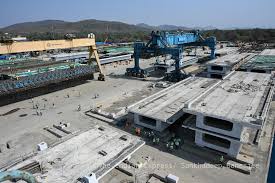
To support this, nine specialized casting yards have been established across Maharashtra. The Sakhare yard, sprawling over 50 acres, is a masterclass in modern construction, where colossal machines—some resembling something out of a Transformers film—operate round the clock.
The Science of the “Flying” Girders
The backbone of this elevated corridor is the precast girder. These massive concrete segments are placed between pillars to form the trackbed.
- Engineering Complexity: Each girder weighs approximately 1,000 tonnes and measures 40 meters in length.
- Design for Strength: Despite their size, they are engineered with a central rectangular opening to reduce weight without compromising integrity. They boast a structural strength of 50 MPa (Megapascal).
- The “Secret” Ingredient: While the concrete provides the form, it is the internal network of high-tensile wires, stretched and locked at both ends, that gives the structure its immense load-bearing capacity.
- Efficient Curing: To save thousands of liters of water, engineers use a specialized chemical compound sprayed on the surface. This white coating retains moisture and reflects sunlight to prevent cracks during the 14-day curing process.
Accelerating the Pace
According to the National High-Speed Rail Corporation Ltd (NHSRCL), approximately 11,500 girders are required for the entire project. To date, nearly 8,500 have already been launched.
L&T officials on-site noted that the pace of construction is aggressive. “We are launching 7–8 times faster than the Japanese,” said one official. While the Gujarat section of the project is nearing 68% completion, the Maharashtra section is accelerating, currently at 41% progress as of March 2026.
A Milestone for Future Transport
The scale of this project is unprecedented in India, comparable only to the complexity seen in the Mumbai Trans Harbour Link. Every girder launch serves as a real-time load test; as a 380-tonne transporter carries a 1,000-tonne girder across the pillars, the structure proves it can handle over 1,400 tonnes of weight—ensuring safety for the next century, regardless of future passenger capacity.
Timeline to Reality
The infrastructure dream is moving toward a firm deadline:
- First Section (Surat to Bilimora): Completion targeted by August 15, 2027.
- Full 508-km Corridor: Expected to be operational by December 2029.
As the Boisar station takes shape near the Arabian Sea, the connection between these high-tech viaducts and the rest of the country is becoming a reality. In Sakhare, the sight of these girders—resembling giant wings spread across the Sahyadri mountains—serves as a symbol of a transforming India.